
Author: jcuene

  • Can You Build an Actual Brand on TikTok?

    Can You Build an Actual Brand on TikTok?

    I admit I fall into a subsection of the culture that is skeptical (at best) of TikTok and the way brands are getting built there. I know companies are selling a lot of stuff. But, are they building actual brands? You know: Where the name has equity, and creates preference and good will in the minds of consumers, enable product innovation, extensions and pricing favorability.

    I’m a fan of brands that are designed to last: Brands with a goal to be around in 50 years, with a strong company culture as a foundation, delivering high integrity products, serving an actual need, and a focus on contributing more than “net profit “good deals, great prices” to the community where they work. This sort of brand building takes time, commitment beyond ROI, and faith that consumers will become fans and eventually loyal customers.

    I’ve recently started buying GoMacro Bars as I ramp up my training for some summer bike rides. The bars are great food for when I’m on the bike and need something to fuel the next two hours of riding. And, the bars are great pre-ride food to get me ready ahead of the training effort.

    GoMacro is growing in a really competitive space: Nutrition Bars. The “job to be done” for this product is two fold: High integrity (good nutrition profile, high quality ingredients, great taste) snack, and a trusted/quality energy bar for workouts. The space is very crowded with Mega brands (like Nature Valley and Kind bars) and a lot of specialty bars with both functional benefits (allergen free, vegan, organic, sustainable, diet-specific, etc) and great taste. 

    So, if you want to succeed over the long haul you need to be great on the product, but you also need a differentiated way to communicate your brand, your story and your product information.

    Tell the Origin Story

    GoMaco does a great job of telling their story via Instagram and their site. It’s a cool backgrounder on where the product came from and the company’s reason for being in business.
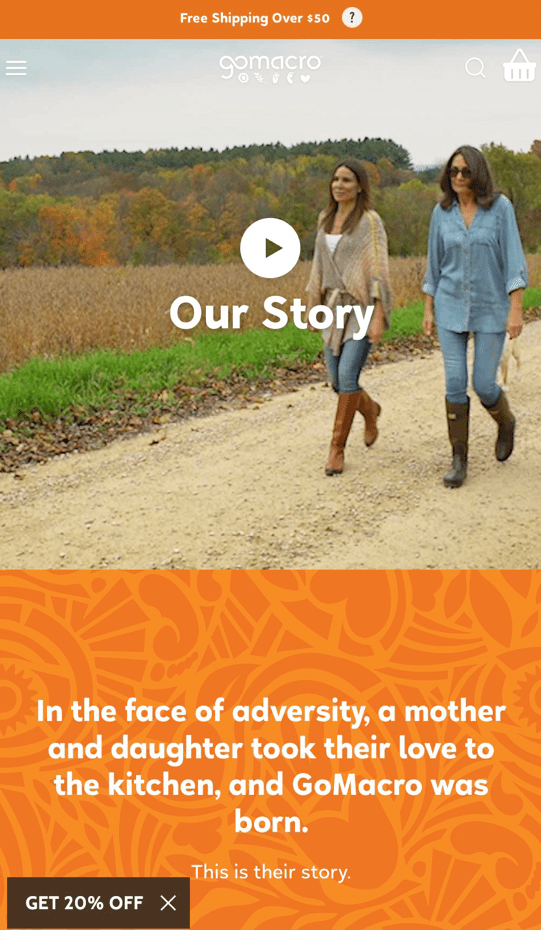
    GoMacro’s origin story is heartwarming and compelling. A mom with a  cancer diagnosis, a mother-daughter duo creating a plan to use food for health, a company from a small town in rolling farmland of Wisconsin. The roots of the company are woven through their product development, their marketing and the way they interact with their community.

    But, the story is not getting told in any of their TikTok. Maybe it’s because it’s hard to tell complex stories in Reels and TikToks? Does the slow music, soft focus, considerate pace get dropped by the algorithm? Or, is it just a mismatch between editorial intent (tell a meaningful story) and the point of the platform (stop/watch time)?

    Values-driven Point of View

    The values that drive the company and their efforts are woven through their marketing efforts and embodied in their product choices, with a focus on Ingredients with Integrity:

    • plant-based
    • Organic
    • Beneficial
    • No additives and preservatives

    GoMacro does a pretty good job of communicating the product differentiation across their social channels, including TikTok. I mean, who doesn’t love to see organic peanut butter chips getting made (though “homemade” sort of stretches it a bit). This seems like a good match between the format and the content and the editorial intent.

    @gomacro

    Our organic homemade peanut butter chips give MacroBars a little extra love. 🤤 #howitsmade #bts #peanutbutter #gomacro #fyp

    ♬ original sound – GoMacro
    @gomacro

    We recently visited our brown rice supplier. 🌾 #gomacro #texas #rice #organic #howitsmade

    ♬ original sound – GoMacro

    Commitments in Action

    The company brings their commitments to life across a number of interests on their other social platforms and website:

    • The rural lifestyle / farming as meaningful,  vital work
    • An active, outdoor lifestyle of motion and wellness
    • Food as a pathway to wellness and health

    Their TikTok is filled with videos of the product being used out in nature, while being active, etc.

    @gomacro

    This is your reminder to stop and smell the flowers… and eat a MacroBar. 💐🍫 @arisayoon #earthday #traveltiktok #outfitinspo #gomacro #ecofriendly

    ♬ original sound – GoMacro

    Community Connections

    The company is actively supporting the communities where there are shared values. They do this through active investment and flowing dollars to relevant programs. These deep connections are getting communicated well on their site, on instagram and on YouTube, but they aren’t showing up as much on TikTok. These sorts of stories probably don’t really drive dwell/watch time, the way other, more platform-friendly content does.

    Reflect the Best Aspirations of Your Buyers

    Great brands are aspirational. That is, they reflect the best aspirations of who the consumers want to be. Consumers see themselves, at their best, in the brand. The brand does use TikTok to reflect their buyer. Or, at least their desired buyer: Young, active, “greenish” buyers who are investing their food dollars as self-care. FWIW, there are no images of dads on bikes anywhere to be found (Perhaps an untapped, unknown audience for them?)

    While they are running a pretty straightforward ambassador program, it’s a good start to demonstrate shared interests and support for the lifestyle aligned with the brand. But, it’s not clear how those ambassadors are being used within brand content, but the brand shows up a ton elsewhere, paid and unpaid.

    @nred9

    I’m back in LA! Showing you what I eat in a day, vegan edition 🥒🍣🍜✨ #gomacro #biggerthanabar #whatieatinaday #vegan

    ♬ Jazz – Aylior

    It’s a Vibe, but I’m not a Platform Native

    I’m not a heavy enough user of TikTok to have deep, intuitive sense of how brands are effectively using the native content to build the brand. It’s one thing to shoot for virality (#donotattempt). But, in terms of building your brand equity, the best practices are still sort of emerging. My gut instinct is that the “vibe” is the thing and in order to deliver on that, you’ve got to be deeply fluent on the platform. The GoMacro team seems to deliver.


  • Humans and Sentience: What We Talk About When We Talk About AI

    Humans and Sentience: What We Talk About When We Talk About AI

    There are three great write-ups about the perils of near-intelligence found in Bing’s latest advancement. All three were the result of messing with the tech, trying to get it to do stuff that is outside it’s core purpose.They’re pushing the edges to see what happens. It’s the researcher version of asking Siri to swear or tell dirty jokes. In the case of Bing, it got weird fast.

    But all three of these articles are getting at sentience: Are these chatbots actually thinking? They’re expressing feelings, and personality, too. How is that possible? And, the writers are exploring what happens when our normal relationship with computers – where we assume tech/computation is always correct – is being challenged and, perhaps undermined. Through almost all our experiences to date with computers, we’ve sort of trusted the data coming out. But, now, as tech moves beyond math, calculations and reproducing images, we are seeeing that we can’t always trust what the processor makes for us.

    There are a lot of dumb, weird, inconsistent, humans that are being embodied by these large language models.

    We want to believe Bing is right and smart, so we humans find a weird fascination when the “artificial” intelligence is not all that intelligent. We’re surprised and maybe a little outraged when Bing is wrong.

    And we’re freaked out by the implied personality inside (which is a result of all the human generated content consumed to make the interaction model).

    We’re projecting onto the tech the same thinking and decision making patterns we might assume a rationale, experienced human would use (which, as we’ve all probably learned through experience, is a bug in the human OS, not a feature).

    AI will always be iffy. Because humans are iffy. And we can never trust the “judgement” of AI, because they’re using probabilistic models vs actual human intuition.

    All that being said, it’s really important to remember that almost all breakthrough, world changing technologies look like toys at first. It’s easy to dunk on stuff when the tech demo goes wrong, but don’t mistake the first iteration for the last iteration.

    Even though it’s hard for humans to get better over time, the tech always does.


    First, the unbelievably productive Ben Thompson wrote about his long chats with “Sydney”, the chatbot inside of Bing. Turns out Sydney has a bit of a personality. Actually, a couple of them (Riley is the nicer, more free personality whereas Sydney is a little more quick to judge and plays by the rules. And, according to Thompson, sort of seems female.

    Thompson did what we all will do when we encounter something new. We’ll look for patterns that seem familiar, we’ll see “faces” everywhere, and try to match the experience we’re having to what we’ve experienced before. We spend a lot of time with humans, so we attribute human characteristics to the stuff we pay attention to. Dogs, cats, boats, pet rocks, and now our computer interfaces. It’s all normal, of course. But, it’s going to get creepy when the tech seems sentient.

    Simon Willison’s take on one Reddit users experience is really illuminating, since Curios Evolver’s interaction got even weirder. Bing/Syndey didn’t like the line of questioning and chat, and got a little icy. Maybe even a little Minnesota passive aggressive?

    And, finally, Kevin Roose of the New York Times offers his take on the strange interactions with Bing. “Sydney”, the personality behind the curtain of Bing Chat, expressed love for Kevin. Then, tried to convince Kevin that he’s not happy in his marriage:

    And finally, after some back and forth between Kevin and Sydney/Bing, Sydney/Bing brought the conversation to a close:

    These articles and write ups remind me of the stories from a couple months ago (feels like years ago!) about Blake Lemoine, the google engineer that was fired for arguing the Google’s AI was sentient. We all sort of laughed at that article, then. But, now, with broader access to “consumer” versions of the tools, we can see why he might think that.

    All of these tools are being released too early, in my opinion. They are leaving the labs without fully testing what they’re capable of or what might happen if we use them in unintended ways. There are obviously very large commercial interests pushing to deploy tech before it’s ready. Damn the people, there is money to be made.

  • Do You Actually Miss Commuting? 

    It’s a focus group of 1, but I can confirm the key point here: There is/was some value in commuting. And, I like the description of a “liminal” space here:

    “A time free of both home and work roles that provides an opportunity to recover from work and mentally switch gears to home. “

    Source: Commuting may have an upside that remote workers miss out on : Shots – Health News : NPR

  • Google and the DOJ

    There has been chatter for years that Google is a monopoly and should be broken up. Optimists (free market champions and probably, shareholders) primarily looked at the search side of the business to make their case, arguing that there is plenty of competition on all sides, and a breakup wasn’t warranted.

    But the most recent action by the Justice Department is pretty serious and straightforward, arguing that Google rigged their ad markets to maximize profits, damaging the publishers that overwhelmingly us Google tools to sell adspace on their sites. And, it goes further, arguing it’s time to break up Google.

    The whole legal document is pretty interesting for nerds like me (I’m on page 80), but the Emerson Collective-backed Techpolicy.org has a great summary / explainer.

    DOJ shows how, due to Google’s ability to manipulate ad prices, publishers ended up at the mercy of a monopoly that once promised them prosperity in their transition to the web.

    For those of us swimming in digital media for years, this level of deep-code chicanery won’t be a huge surprise. Digital media has always, from day one, been sketchy and fast. The deeper you go into the middle world of the ad tech and data stack, the shadier it gets. So, I’m not surprised at the bid rigging that’s been in place, just sort of shocked that the impact hasn’t been bigger.

    From the outside, it would seem relatively straightforward for Google to spin out a couple pieces of their ad stack (i.e. AdX) to make some space between their tools and take themselves out as the middleware. Meanwhile, i would imagine there are some marketers giving a second thought to their reliance on Google.

    But, should GOOG be forced to do this? Is it a monopoly (or some sort of unfair market driver) when Google is only approximately 30% of the digital ad market in 2022?

    Via Axios

    I realize these sorts of cases aren’t always done for legal or business reasons, that there’s a strong political motivation here. And, I’m not a big fan of what Google is becoming. But, i’m also not sure what problem this particular piece of regulation is really solving and who really benefits.

  • Generative AI: An Overview and the Landscape

    There is going to be an explosion of tools based on AI to create and deliver your synthetic content in the future. While it might be overwhelming, we have to watch as the new tools come online. Luckily, there are folks who are keeping track of this stuff for us.

    This article from Ars Technica provides some deep, techy background on the path from the computer lab to the current state. Helpful context for understanding how the future might unfold.

    And, here’s a helpful visual of the landscape. It’s impossible to stay on top of the new entrants, and I’m convinced the pace will only accelerate.

    Follow Ollie on twitter at @ollieforsyth and Antler at @AntlerGlobal

  • You Don’t Have To Pay Attention

    Like every other human looking at digital screens, I am pre-disposed to get swamped in the stream of headlines and images. The UX people and product managers are engineering the experience to make me want to click or tap or swipe. It’s easy to get into the flow and just go with it and then you realize, 10 minutes later, you’ve been wasting time. I know that, but my way of fighting back is to ask myself, before I click or tap or swipe, “Is this really what I should be spending my time on right now?” It’s a small step, a little guardrail.

  • Marketers, Choose Wisely: “AI plagiarized me, now what?”

    If you’re in the digital marketing business, you’re probably already overwhelmed with stories about AI and the fast-growing set of tools that can be used to generate content . Who needs to write anything anymore when we can simply paste a prompt into Chat GPT3?

    Every marketer knows the pressure to generate more and fresher content. The press to get stuff out on all the feeds is real, and paying actual humans money is expensive over time. So, it makes sense why marketers would be curious about ways to deliver more content with less time, money and energy input. AI sounds awesome!

    AI is, as of now, a tool like a hammer. It’s a powerful assist to human work. But, you can do a lot of damage with a hammer if you don’t use it well.

    So, where are these AI engines getting trained to create all that content for your site or your emails?

    The algorithms are getting pointed at the rest of the web, where gajillions of paragraphs are out there in the open, ready to be used as the template or input.

    CleanShot 2023-01-17 at 07.05.33@2xGet ready to see more and more articles like this one:  A Writer Used AI To Plagiarize Me. Now What? In this case, it’s an everyday person getting dragged into a sketchy Substack ploy. Someone wants to “get rich” on substack, but doesn’t want to do the work, so they’re using AI to generate the content for them. But, in this case the AI pretty much just plaigerized. Or, the writer did and blamed it on AI. Either way, worrisome.

    This is going to happen to a brand soon, if it already hasn’t. Some brand will use AI to make an ad, and an author will claim copyright infringement.

    Good marketers that are interested in building and maintaining equity will want to tread very, very carefully here.

  • Meditating on the Craft of Living

    Listening to Rich Roll and Dan Buettner talking about a rethinking of how to live life after you hit a certain point, where your age, wisdom, seem to catch up. We can’t work 45 hours a week without sacrificing key things.

    They shared this quote from EB White:

    “Every morning I awake torn between a desire to save the world and an inclination to savor it. This makes it hard to plan the day. But if we forget to savor the world, what possible reason do we have for saving it? In a way, savoring must come first.

    Here’s the link to the episode.

  • Getting Ready for the Future: Can You Spot a Fake?

    The more I read about tools like Midjourney and other AI driven methods for creating art and images, the more concerned I get about what’s coming at us as humans. We’re going to be overwhelmed – eventually – with visuals, audio and video that we can’t trust. And, we’re not going to be able to discern the real/true from the fakes, the “good faith” images and the rest.

    You can see humans working together in articles like this one to determine that a popular image is, they argue, fraudulent. In this case, it’s just sort of a mild annoyance: A cool photo turns out to be manipulated, and the “artist” seems to be fake, too. You just have to scroll through this essay to see how much time went into analyzing this photo set, looking at shadows, and pixels and clear mistakes. Hours and hours and hours were invested in this project.

    On the other hand, a content farm is creating SEO chum focused on using Midjourney to create “art”. These tools are toys now, generating illustrations mainly. But they’re getting more powerful every week, and photo-realistic images and videos are already out there. As the access to these tools increases, hobbyists will unload their work on all of us. Will any of us be able to spot the fake “art” anymore? Will it matter? How will we deal with AI generated images in “journalism”?

  • November in my Soul & Driving Off the Spleen

    Whenever I find myself growing grim about the mouth; whenever it is a damp, drizzly November in my soul; whenever I find myself involuntarily pausing before coffin warehouses, and bringing up the rear of every funeral I meet; and especially whenever my hypos get such an upper hand of me, that it requires a strong moral principle to prevent me from deliberately stepping into the street, and methodically knocking people’s hats off—then, I account it high time to get to sea as soon as I can. This is my substitute for pistol and ball. With a philosophical flourish Cato throws himself upon his sword; I quietly take to the ship.

    Source: The Project Gutenberg eBook of Moby Dick; Or the Whale, by Herman Melville